Sleeping Positions for When the Baby Has Her Feet in Ur Ribs
During pregnancy, the developing baby moves into several different positions. As labor approaches, some positions are safer than others.
The ideal position for a fetus just before labor is the anterior position. In this position, the fetus's caput points toward the footing and they are facing the woman's back.
Well-nigh fetuses settle into this position by the last calendar month of pregnancy. The anterior position is also known equally a vertex, cephalic, or occiput anterior position.
The anterior position may reduce the chances of complications during pregnancy. Learn more about this and other fetal positions in the womb in this article.
Possible positions of a developing baby in the womb include:
Inductive position
The best position for the fetus to be in earlier childbirth is the inductive position. The majority of fetuses go into this position before labor begins.
This position means the fetus'south caput is down in the pelvis, facing the woman'south back. The fetus'south back will be facing the woman'due south belly.
This position means the fetus's head can be tucked in, allowing the elevation of it to press down on the cervix, which encourages it to open up during labor.
A doc or midwife may describe a fetus that lies slightly to the left as left occiput anterior or LOA, and one that lies slightly to the right as correct occiput inductive or ROA.
Posterior position
The posterior position is also known as the back-to-back position. This is where the fetus's caput is pointing downward, and their back is resting against the woman'due south back.
In this position, it tin be difficult for the fetus to tuck their head in, which can make passing through the smallest part of the pelvis more than challenging. This can lead to a slower and longer labor than the anterior position, and may too cause a backache.
A fetus may be more than probable to end upwards in this position if the mother spends a long fourth dimension sitting or laying down, such as if she is on bed balance.
The back of a fetus'due south body is heavier than the forepart, so a pregnant woman can encourage the fetus to coil into the ideal position by leaning in the direction they desire them to move.
Transverse lie position
A transverse lie position is when the fetus is lying horizontally in the uterus. Near fetuses will not remain in this position in the weeks and days leading up to labor.
If a fetus is still in the transverse lie position just before birth, a cesarean delivery volition be necessary.
Without a cesarean delivery, there is a risk of a medical emergency known as an umbilical string prolapse.
When an umbilical string prolapse occurs, the adult female delivers the umbilical cord in the birth canal earlier the baby.
Breech position
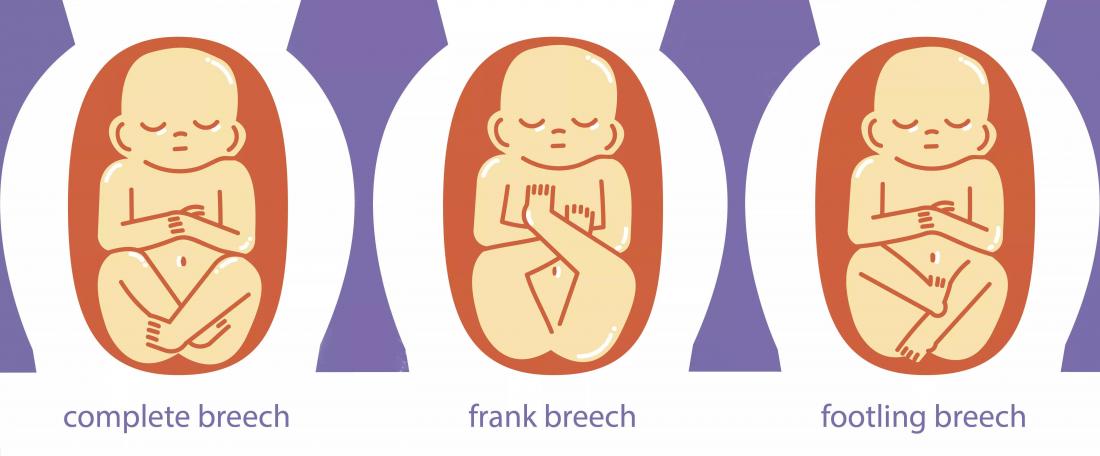
The breech position is when the fetus remains with the head up instead of down in the woman's pelvis. There are dissimilar types of breech position, including:
- Frank breech: In this position, the fetus'south legs lie straight upward in front of their torso, so the feet are nigh the face.
- Consummate breech: In this position, the fetus "sits" with their legs crossed in front of the body, and then the feet are virtually their buttocks.
- Footling breech: In this position, the fetus has either one or both anxiety hanging below their lesser. If a adult female gave birth vaginally, i or both feet would come out beginning.
Reasons why a fetus may remain in the breech position include:
- too much or likewise little amniotic fluid surrounding the fetus
- uterine fibroids
- an irregularly shaped uterus
- multiple fetuses in the womb
If a woman is carrying twins, one fetus may be in an anterior or posterior position while the other fetus is in a breech position.
Information technology is safe for a fetus to be in any of the higher up breech positions while they are in the womb. However, there are some risks if the fetus is nevertheless in a breech position when labor begins.
The best way of finding out which position the fetus is in is by talking to a md or midwife.
At each appointment during the 2nd and third trimesters of pregnancy, a doctor or midwife should experience the woman's abdomen to check the position of the fetus.
At the 35–36 week appointment, they will check to ensure that the fetus has moved into an anterior or posterior position. If the doctor is unsure almost whether the fetus is in the right position subsequently a physical examination, they may request an ultrasound scan.
It may besides be possible for the woman to tell which position the fetus is in at dwelling house.
When the fetus is in the dorsum-to-back or posterior position, the pregnancy bump may feel squishy. A adult female may also detect kicks around the middle of the abdomen, and some people may also meet an indentation around their navel.
When the fetus is in the inductive position, a woman may experience more kicks under the ribs. Their abdomen push may also "pop out."
Most fetuses turn into the head-down position by 36 weeks. If a fetus is in a breech position at 36 weeks, a doctor or midwife may suggest an external cephalic version (ECV).
An ECV is a procedure where a doctor or midwife will try to turn the fetus manually.
For this procedure, they will first insert a pocket-size needle into the woman's hand to relax the uterus.
Using their hands on the exterior of the significant woman's belly, a dr. or midwife will then gently dispense the fetus from a breech position into a transverse lie position, and so into a head-downwardly position.
Some fetuses plough by themselves subsequently 36 weeks, and some fifty-fifty turn during labor.
Some people recommend moving into certain positions, taking herbal medicines, and doing detail exercises to help babies in breech plow to the more favorable birthing position. However, there is no reliable prove to prove that whatever of these methods work.
If a person does wish to endeavor these medicines or techniques, it is vital to consult a doctor first.
A infant will motility into many different positions throughout pregnancy. During the last few weeks of pregnancy, virtually babies move into an anterior position, which is the all-time position for vaginal nascency.
If a baby is even so in a transverse lie or breech position just before labor, a doctor or midwife volition brand medical interventions to ensure the safety of the adult female and baby during childbirth.
Source: https://www.medicalnewstoday.com/articles/323099
0 Response to "Sleeping Positions for When the Baby Has Her Feet in Ur Ribs"
Postar um comentário